
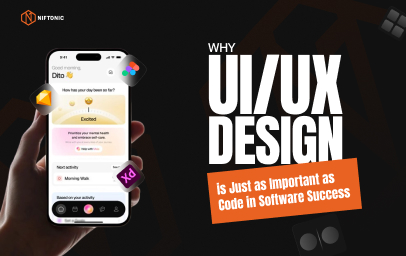

When we talk about software development, most people immediately think of programming languages, clean code, and backend architecture. And while all of that is undeniably crucial, there’s another side to the equation that’s just as important — if not more so for the end user: UI/UX design.
At Niftonic, we believe that great software isn’t just built — it’s experienced. No matter how powerful your codebase is, if users find the interface clunky, confusing, or unpleasant, your product will struggle to succeed. In this blog post, we explore why UI (User Interface) and UX (User Experience) design are just as important as the code behind your product.
What is UI/UX Design?
- UI (User Interface) focuses on the visual and interactive elements — like buttons, icons, color schemes, typography, and layout. It’s what the user sees and touches.
- UX (User Experience) is about the overall feel and functionality of a product. It involves user flows, usability, accessibility, feedback loops, and how intuitive the experience is.
In simple terms: UI is how it looks; UX is how it works.
First Impressions Matter
A user’s first impression of your software can happen in less than 10 seconds — and often before they even interact with a feature. If the layout looks outdated or cluttered, if the navigation is confusing, or if buttons don’t respond well, users will likely leave before discovering what your software actually does.
No amount of elegant backend code can save a bad first impression.
Usability Impacts Retention
Imagine a beautifully coded app that helps manage finances. The algorithms work flawlessly. But the UI is unintuitive — users can’t find key features, the color contrast is poor, and there’s no clear feedback when actions are taken.
What happens? Users abandon the app. Not because the code failed, but because the experience did.
Good UX design increases user retention, satisfaction, and even referrals. It’s not just a visual layer — it’s the layer people interact with the most.
UI/UX Directly Impacts Conversions
Whether your software’s goal is to convert users into customers, subscribers, or leads, the UI/UX plays a critical role.
- Are CTAs (Call-to-Actions) easy to find?
- Is the form simple to fill out?
- Can users complete tasks in just a few steps?
Even minor UX improvements — like clearer button labels or streamlined onboarding — can drastically increase conversion rates. Behind every smooth experience is intentional, well-researched design.
Design Enhances Brand Trust
Users often judge a brand’s credibility based on its digital interface. A modern, clean, and responsive design signals professionalism and attention to detail. On the flip side, a confusing or outdated UI can suggest that your product (and company) is unreliable or behind the times.
In many cases, your UI is your brand’s first handshake with the user — and it should feel confident, helpful, and trustworthy.
Collaboration is Key: Designers & Developers Working Together
At Niftonic, we don’t treat design and development as separate silos. Instead, we integrate UI/UX designers early in the process, working closely with developers to ensure the final product is both beautiful and functional.
This collaboration means:
- Designs are technically feasible and scalable.
- Developers understand the intent behind user flows.
- The final product matches the original vision — pixel by pixel.
When designers and developers are aligned, the result is a seamless experience that feels natural to users.
Real-World Examples of Design-Driven Success
Think of products like Airbnb, Spotify, or Slack. What makes them stand out isn’t just functionality — it’s how easy and enjoyable they are to use.
- Airbnb makes booking a home intuitive and visual.
- Spotify simplifies music discovery through thoughtful UX.
- Slack turns communication into a fluid, productive experience.
All of these are powered by complex code — but they’re remembered because of outstanding design.
UI/UX is Not a One-Time Task
Just like code needs updates and refactoring, UI/UX needs ongoing attention.
- Are users dropping off during onboarding?
- Is there confusion around certain features?
- Are competitors offering smoother interactions?
Continuous feedback, testing, and design iteration keep your software aligned with evolving user expectations.
At Niftonic, we use tools like user heatmaps, usability tests, and A/B testing to continually refine the experience — long after launch.
Final Thoughts
You can have the most robust code in the world — but if users struggle to interact with it, your product won’t reach its full potential. UI/UX design isn’t just about aesthetics; it’s about clarity, usability, emotional connection, and ultimately, success.
At Niftonic, we believe that design and development should go hand-in-hand. That’s why every project we deliver is backed by strong UX research, thoughtful UI design, and scalable code — all working together to create a product users love.
Looking to build software that not only works but delights?
Let’s create something that users want to come back to — again and again.


