
Why Custom Software is the Future of Business Efficiency.

In an era where technology drives every aspect of business, the tools companies use to operate can be the difference between thriving and just surviving. Off-the-shelf solutions may offer convenience and speed, but increasingly, businesses are turning to custom software to gain the flexibility, scalability, and efficiency needed to stay competitive. At Niftonic, we’ve witnessed first-hand how custom solutions can transform operations, streamline workflows, and enable smarter decision-making. The Shift Toward Customization Off-the-shelf software products are designed for the masses — and therein lies the problem. These tools often come loaded with features you don’t need and lack the ones you do. This can lead to inefficiencies, workarounds, and poor user adoption. In contrast, custom software is built from the ground up, tailored specifically to your business’s unique needs, processes, and goals. When your technology fits your business like a glove, teams can focus on what they do best — delivering value. Whether you’re a startup aiming to scale fast or an established enterprise optimizing legacy systems, custom development puts control in your hands. One Size Does Not Fit All Consider a logistics company managing hundreds of shipments daily. An off-the-shelf CRM might handle customer data but fail to integrate seamlessly with fleet tracking, invoicing, or compliance checks. A custom-built solution can unify these touchpoints, offering a single dashboard for real-time insights, automated workflows, and improved decision-making. The same applies across industries. In healthcare, education, retail, and finance, custom software addresses industry-specific challenges in a way no generic platform ever could. Key Benefits of Custom Software Development Let’s break down why investing in custom software development makes strategic sense: 1. Personalized Fit Custom applications are designed to match your workflows, not the other way around. This improves user satisfaction and productivity across departments. 2. Scalability As your business grows, so can your software. With custom development, it’s easy to add new features, scale performance, or integrate emerging technologies like AI or IoT. 3. Enhanced Security Custom solutions provide better control over security protocols. You’re not at the mercy of widespread vulnerabilities that could impact thousands of users on a shared platform. 4. Cost Efficiency Over Time While upfront costs may be higher than a subscription model, custom software becomes more economical in the long run. You’re not paying for unnecessary licenses, support you don’t use, or upgrades that don’t add value. 5. Integration Ready Custom apps are built to communicate with your existing tools — whether that’s your ERP, third-party APIs, or internal systems — enabling a connected, intelligent business ecosystem. How We Approach Custom Development at Niftonic At Niftonic, we follow a user-centered, iterative approach to development. Our process involves deep collaboration with our clients, ensuring we not only understand their business goals but also the context in which users will interact with the product. Here’s a brief look at our approach: We specialize in web apps, mobile applications, enterprise platforms, and cloud-based solutions — and we build with scalability, speed, and future-readiness in mind. Real-World Results One of our recent clients in the fintech space faced challenges with disjointed data sources and manual reporting processes. Our team developed a custom dashboard that unified data streams from multiple departments and integrated AI-powered insights. The result? A 40% reduction in operational overhead and a 2x improvement in decision-making speed. Another retail client saw a 30% increase in customer satisfaction after we developed a custom mobile app with personalized recommendations and seamless checkout functionality. Is Custom Software Right for You? While custom software can unlock incredible value, it’s not for every situation. Businesses with highly standard operations or tight budgets may still benefit from off-the-shelf solutions — at least in the short term. However, if your business has unique workflows, complex requirements, or aggressive growth goals, a tailored solution can be your biggest asset. At Niftonic, we’re not just developers — we’re problem solvers, strategists, and innovation partners. We believe in building software that doesn’t just work but works for you. Ready to Build the Future? If you’re ready to transform the way your business operates, we’d love to talk. Let’s build something powerful — together. Want to start your custom software journey?Contact Niftonic today and schedule a free consultation with our experts.
The Rise of Low-Code & No-Code: Should You Be Concerned or Excited?

In recent years, low-code and no-code platforms have exploded in popularity — promising faster development, lower costs, and empowering non-developers to build apps and automate workflows with ease. Naturally, the rise of these tools has stirred a mix of curiosity, excitement, and concern across the tech industry. At Niftonic, we believe it’s not a matter of whether low-code/no-code (LCNC) tools are good or bad — it’s about understanding their place in the software ecosystem. In this post, we’ll break down what LCNC means, where it works best, its limitations, and whether businesses should embrace or avoid it. What Are Low-Code and No-Code Platforms? Examples include Bubble, OutSystems, Appgyver, Airtable, Zapier, and Webflow — enabling users to create everything from internal tools and automations to full-fledged mobile apps. Why Are These Platforms Gaining Traction? So, Should Developers Be Worried? Short answer: No.While low-code/no-code is disruptive, it doesn’t replace experienced software engineers. It changes the landscape — but in a way that creates new opportunities. Here’s why developers and companies like Niftonic should be excited, not threatened: Where LCNC Works Well For businesses that need something functional now, LCNC platforms can serve as a launchpad or temporary solution. But Let’s Be Honest — LCNC Has Its Limits Despite the hype, LCNC platforms aren’t a silver bullet. Here are a few common limitations: At Niftonic, we’ve helped several clients migrate from no-code platforms to fully custom solutions once they outgrew the limitations — without losing momentum or their user base. How We See It at Niftonic We see low-code and no-code as part of the future — not the enemy of it. Our team uses LCNC strategically when it benefits a project timeline or client budget. But when performance, control, or customization matters most, we build from the ground up using modern frameworks and scalable cloud infrastructure. We also help clients make the right call: sometimes that means starting with Bubble or Glide to validate an idea, then rebuilding it with React Native, Node.js, or Flutter once it’s ready to scale. Final Thoughts Low-code and no-code platforms are changing the way software gets built — making it more accessible, faster, and in some cases, more affordable. But they’re not a replacement for experienced developers or custom software. Instead, they are a complementary toolset — one that smart businesses and modern development teams can use to innovate faster. So, should you be concerned or excited?At Niftonic, we say: be excited — and stay informed. Need help deciding between no-code, low-code, or full-code for your next project?Let’s talk. Our team will help you build smart, whether you’re prototyping or scaling.
Understanding Agile Development: What Clients Need to Know

In the fast-paced world of technology, where market needs evolve quickly and innovation is constant, software development must be equally adaptive. That’s where Agile development comes in. As a client partnering with a software development company like Niftonic, understanding Agile isn’t just helpful — it’s essential. Agile is more than a buzzword or a project management trend. It’s a mindset and framework that directly impacts your project’s timeline, quality, communication, and end result. In this post, we break down what Agile really means, how it works, and what you need to know as a client to get the most out of the process. What is Agile Development? Agile is an iterative and collaborative approach to software development that prioritizes: Instead of building an entire product behind closed doors and delivering it months later, Agile encourages teams to work in short cycles (called sprints), test frequently, and adapt quickly. The goal? To deliver a usable product faster — one that evolves with your needs, rather than becoming outdated by the time it’s launched. Agile vs. Traditional (Waterfall) Approach To better understand Agile, it helps to compare it to the traditional Waterfall method: Feature Waterfall Agile Development flow Linear and sequential Iterative and incremental Feedback After final delivery Ongoing, throughout development Flexibility Difficult to adapt to changes Designed to embrace change Delivery At the end of the project Delivered in frequent releases Client role Limited after initial scope Involved at every stage How Agile Works: A Quick Breakdown What This Means for You as a Client Agile isn’t just a development framework — it’s a collaboration style. And as a client, your involvement shapes the outcome. Here’s what to expect: ✅ More Visibility You’ll have access to real-time updates, demo reviews at the end of each sprint, and transparency into what’s being built and why. ✅ Faster Time to Market By delivering usable features early, you can launch a Minimum Viable Product (MVP) quickly, test it in the real world, and start gaining traction while we continue refining. ✅ Flexibility to Pivot New ideas or market shifts? No problem. Agile welcomes change, even late in development. ✅ Better End Product Frequent testing and feedback help catch bugs, usability issues, or misalignments early — saving time and cost later. Common Misconceptions About Agile Let’s clear up a few myths we often hear: How Niftonic Uses Agile with Clients At Niftonic, we tailor Agile processes to fit our clients’ needs — whether you’re building a mobile app, enterprise dashboard, or a cross-platform solution. Here’s how we ensure Agile works for you: We believe that Agile only works when clients are seen as true partners — not just stakeholders. Final Thoughts Agile development has redefined how modern software is built — but its real power comes from collaboration. When clients understand the process, stay involved, and give regular feedback, the results are faster, better, and more aligned with their goals. So, if you’re planning a new digital product or software solution, ask your development partner: “Do you use Agile?” And if you’re working with Niftonic — you can trust that the answer is yes, and that we’ll guide you every step of the way. Ready to build smarter, faster, and more flexibly?Let’s chat. We’ll help you turn your vision into a working product — one sprint at a time.
Why UI/UX Design is Just as Important as Code in Software Success
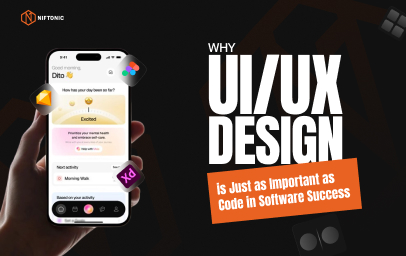
When we talk about software development, most people immediately think of programming languages, clean code, and backend architecture. And while all of that is undeniably crucial, there’s another side to the equation that’s just as important — if not more so for the end user: UI/UX design. At Niftonic, we believe that great software isn’t just built — it’s experienced. No matter how powerful your codebase is, if users find the interface clunky, confusing, or unpleasant, your product will struggle to succeed. In this blog post, we explore why UI (User Interface) and UX (User Experience) design are just as important as the code behind your product. What is UI/UX Design? In simple terms: UI is how it looks; UX is how it works. First Impressions Matter A user’s first impression of your software can happen in less than 10 seconds — and often before they even interact with a feature. If the layout looks outdated or cluttered, if the navigation is confusing, or if buttons don’t respond well, users will likely leave before discovering what your software actually does. No amount of elegant backend code can save a bad first impression. Usability Impacts Retention Imagine a beautifully coded app that helps manage finances. The algorithms work flawlessly. But the UI is unintuitive — users can’t find key features, the color contrast is poor, and there’s no clear feedback when actions are taken. What happens? Users abandon the app. Not because the code failed, but because the experience did. Good UX design increases user retention, satisfaction, and even referrals. It’s not just a visual layer — it’s the layer people interact with the most. UI/UX Directly Impacts Conversions Whether your software’s goal is to convert users into customers, subscribers, or leads, the UI/UX plays a critical role. Even minor UX improvements — like clearer button labels or streamlined onboarding — can drastically increase conversion rates. Behind every smooth experience is intentional, well-researched design. Design Enhances Brand Trust Users often judge a brand’s credibility based on its digital interface. A modern, clean, and responsive design signals professionalism and attention to detail. On the flip side, a confusing or outdated UI can suggest that your product (and company) is unreliable or behind the times. In many cases, your UI is your brand’s first handshake with the user — and it should feel confident, helpful, and trustworthy. Collaboration is Key: Designers & Developers Working Together At Niftonic, we don’t treat design and development as separate silos. Instead, we integrate UI/UX designers early in the process, working closely with developers to ensure the final product is both beautiful and functional. This collaboration means: When designers and developers are aligned, the result is a seamless experience that feels natural to users. Real-World Examples of Design-Driven Success Think of products like Airbnb, Spotify, or Slack. What makes them stand out isn’t just functionality — it’s how easy and enjoyable they are to use. All of these are powered by complex code — but they’re remembered because of outstanding design. UI/UX is Not a One-Time Task Just like code needs updates and refactoring, UI/UX needs ongoing attention. Continuous feedback, testing, and design iteration keep your software aligned with evolving user expectations. At Niftonic, we use tools like user heatmaps, usability tests, and A/B testing to continually refine the experience — long after launch. Final Thoughts You can have the most robust code in the world — but if users struggle to interact with it, your product won’t reach its full potential. UI/UX design isn’t just about aesthetics; it’s about clarity, usability, emotional connection, and ultimately, success. At Niftonic, we believe that design and development should go hand-in-hand. That’s why every project we deliver is backed by strong UX research, thoughtful UI design, and scalable code — all working together to create a product users love. Looking to build software that not only works but delights?Let’s create something that users want to come back to — again and again.
How to Choose the Right Tech Stack for Your Web or Mobile App
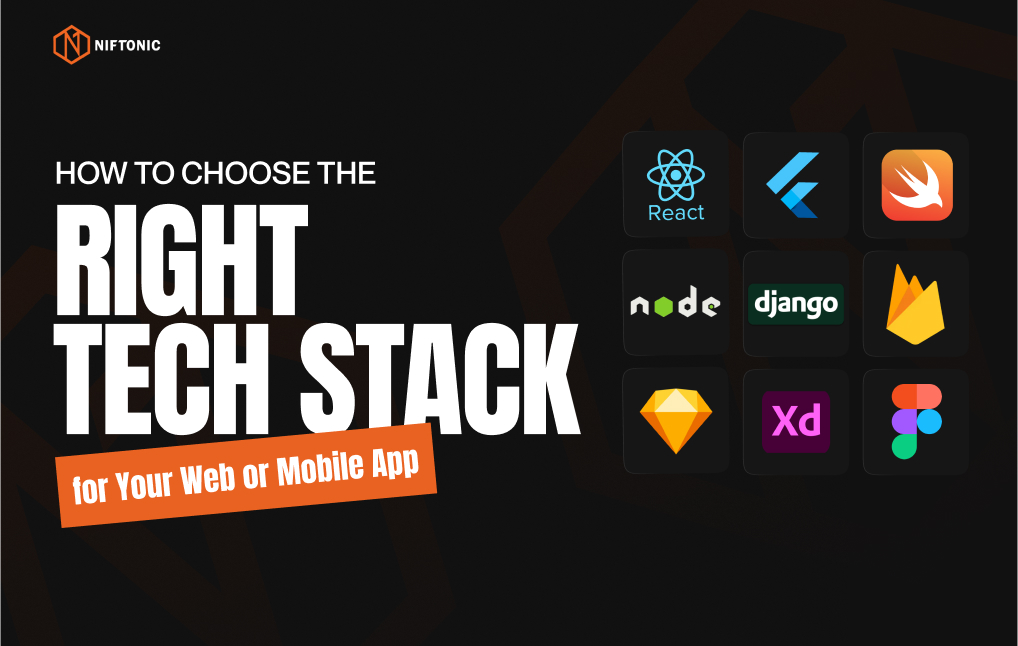
Choosing the right tech stack for your web or mobile app is one of the most important decisions you’ll make at the start of your software development journey. It affects not only how your app is built, but also how it performs, how scalable it is, how secure it can be, and how much time and money it will take to maintain. At Niftonic, we’ve helped startups, SMEs, and enterprises build successful digital products using the right mix of tools and technologies. In this article, we’ll walk you through what a tech stack is, why it matters, and how to choose the right one for your project. What is a Tech Stack? A tech stack is the combination of programming languages, frameworks, libraries, databases, and tools used to build and run an application. There are two primary parts: Together, they form the foundation of your app. Why the Tech Stack Matters Your tech stack directly impacts: Choosing the wrong stack can slow down your launch, make future updates more difficult, and even limit what your app can do. Factors to Consider When Choosing a Tech Stack Let’s break down the key things you should consider when selecting the right technologies for your app: 1. Project Requirements Start by clearly defining: The answers to these questions help narrow down your stack. For example, real-time chat apps may benefit from Node.js, while data-heavy apps might require PostgreSQL or MongoDB. 2. Time to Market If you’re on a tight schedule, go for a tech stack that allows rapid development. At Niftonic, we often recommend these solutions for startups needing to validate their idea quickly. 3. Budget and Resources The tech you choose affects both your initial development cost and long-term maintenance. Also consider the availability of developers. If it’s hard to find experienced developers for a niche technology, your costs will rise. 4. Scalability Think beyond the launch. Choose a stack that can grow with your business. For example, microservices architecture and cloud-native platforms (like AWS or Google Cloud) support scaling better than tightly coupled monolithic systems. 5. Security Some stacks offer better security features out of the box. If your app handles sensitive data — like payments, healthcare info, or user credentials — prioritize tech stacks that are proven to be secure and well-maintained. Look for frameworks with built-in authentication, encryption, and compliance support. 6. Community & Support Technologies with large communities are usually safer to bet on. Why? Stacks like React, Node.js, Django, and Flutter have massive developer ecosystems, which means better long-term support. Popular Tech Stack Combinations Here are some tried-and-true combinations depending on your project type: For Web Apps: For Mobile Apps: Our Approach at Niftonic At Niftonic, we don’t push a one-size-fits-all tech stack. We assess each client’s business needs, project scope, budget, and long-term goals before recommending the best mix of tools. Our goal is always to build reliable, scalable, and maintainable software using technologies that are right for you — not just trendy. Conclusion Choosing the right tech stack isn’t just a technical decision — it’s a business decision that can shape the success or failure of your app. By carefully evaluating your goals, budget, and growth plans, and consulting with experienced developers, you can ensure your product is built on solid ground. If you’re unsure where to start or want expert guidance in selecting the best technologies for your next app, Niftonic is here to help. Let’s build something great together — with the right tools, from day one.